
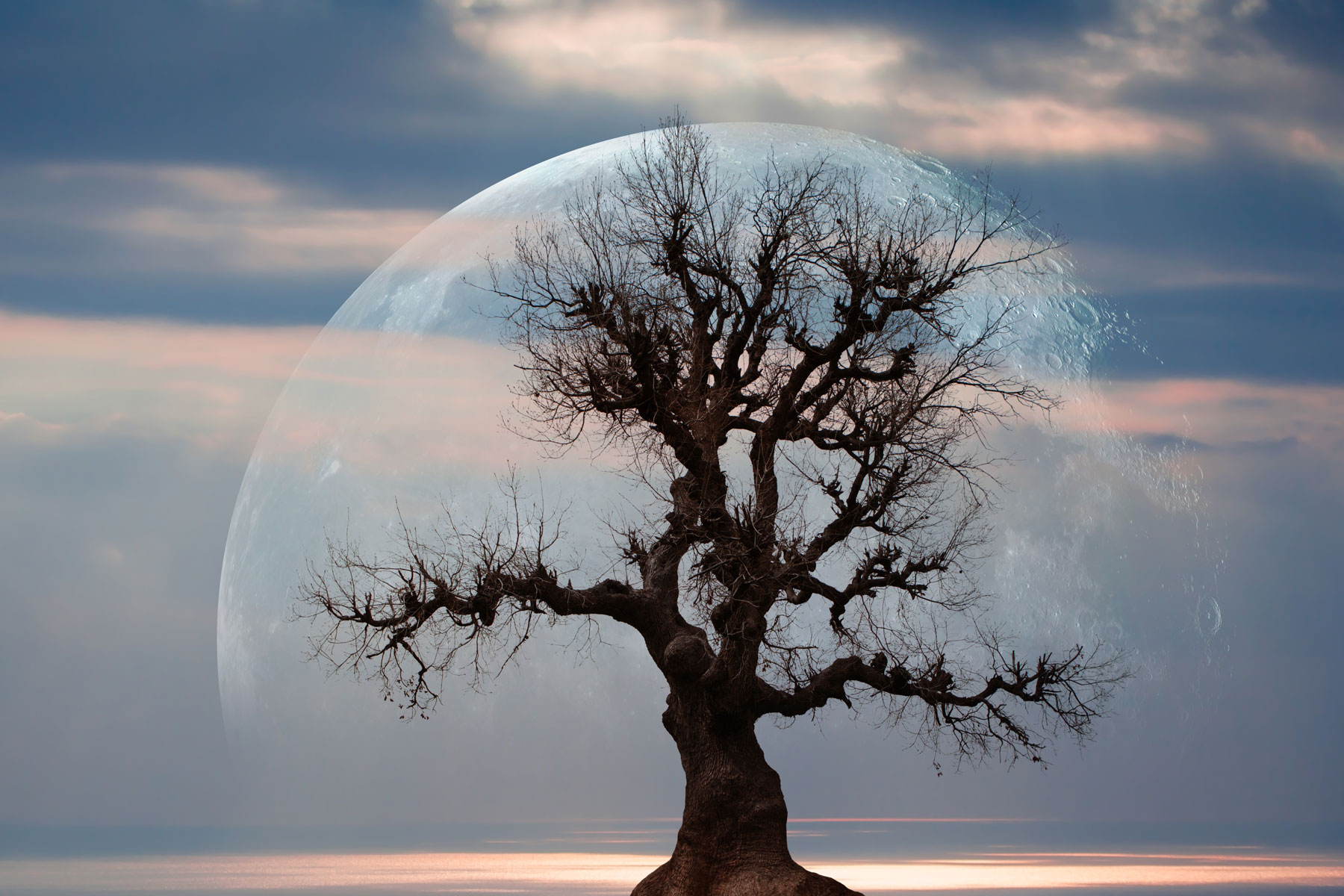
The New Moon is the dark moon. No light shows in the sky, and no one is watching. It is the oldest image we have of the solitary path: work that begins in darkness, unseen, before anything is ready to be shown on the road ahead.
Some men begin the Rite alone. Some live far from any Grove. Some are drawn to quiet more than to the circle. Others move between the two, keeping a private practice alongside their time in communion with their brothers. Many gay and bisexual men first found the Craft on their own, through a book, a candle, or a private longing, long before they found brothers to share it with. In the United Rite, none of this is a lesser way. Solitary witchcraft is one of the oldest expressions of our ancient custom.
This is true across the wider Pagan world as well. Writing for Harvard Divinity School’s Center for the Study of World Religions in 2025, the scholar Helen Berger noted that about three-quarters of Pagans now describe themselves as solitary practitioners, and that the share is even higher among those under twenty-five. The solitary is not the exception. For many, it is the heart of the work.
Inward, not separated
To walk alone is not to stand apart from your brothers. It is not a deficiency. Quite the contrary. It is to turn inward. The solitary tends the mysteries in private rooms and along forest paths. Its workings operate in the inner chambers of the self, which are perhaps the most demanding of all.
Scott Cunningham, whose guides opened solitary practice to countless seekers, insisted that a rite performed alone, or a self-initiation, carries no less power than one done in a group. He urged practitioners to create as well as receive. Berger calls that conviction revolutionary. In the United Rite, we hold it as our own.
The three principles, practiced alone
The Rite rests on three principles, and each finds a particular home in solitary work.
Ascēsis, practice, is the backbone of the solitary path. With no circle to gather you, it is your own discipline that brings you back to the altar: the daily devotion, the meditation kept even when it feels dry, the slow work repeated until it becomes part of you.
Oblatio, devotional service, needs no audience. A candle lit in an empty room is lit for its own sake. An offering left for the Ancients is witnessed only by them. Alone, devotion sheds performance and becomes what it is.
Aequilibritas, equipoise, reminds us that solitude and community are not opposites but two pans of one scale. The solitary practitioner learns balance between silence and speech, between his own revelation and the wisdom of the lineage, and between the time he keeps alone and the times he joins his brothers.
Held by the Rite
Even alone, you are never unaccompanied. The currents of the Rite run through every member, whether he stands in a full circle or kneels at a small altar a thousand miles from the nearest Grove.
The United Rite is a nexus for every one who practices alone, whether always or only sometimes. We share teachings and information so that no solitary has to rebuild the tradition from scratch. Our educational work, drawn from the Rite’s living archive of history and tradition, equips each man to deepen his own practice. And our outreach, both online and in person, offers a way to find your brothers, join the seasonal celebrations as you’re able, and seek guidance when the path grows unclear. No matter how often you join us, you belong here.
A door that opens quietly
If the solitary path is calling you, let this New Moon be your beginning. You don’t need a grand ritual. Light a single candle as dusk falls. Take one slow breath. Give a moment of full attention to the dark sky, and to whatever is stirring in you.
Beginning alone is still beginning. In the United Rite, we honor every solitary journey as part of the path we share.
Blessed be.