The Holy Tides
The Seasonal Cycle of the Year
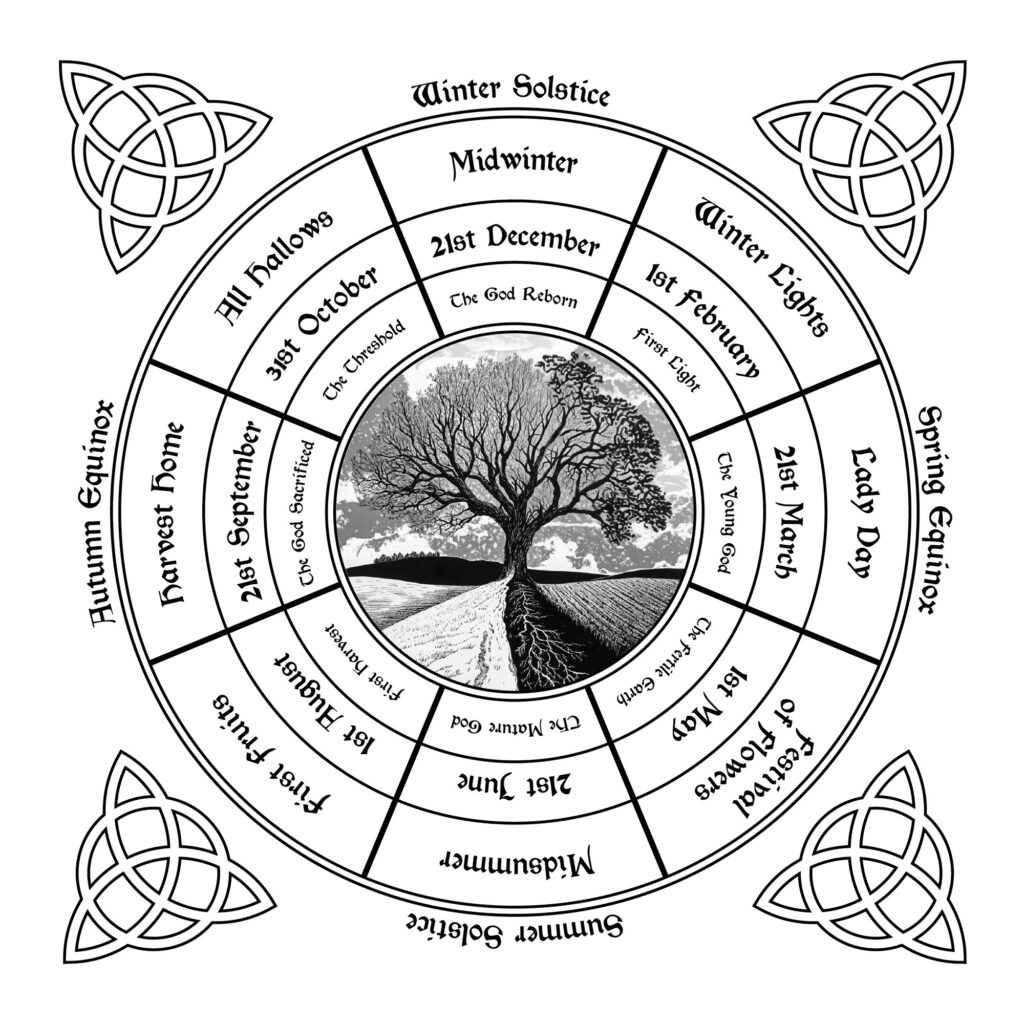
The Holy Tides are the turning points of our year, the eight festivals through which the United Rite keeps time with the land, the sky, and the old gods. Our calendar is a reconstruction. It draws on what survives of the Old English pre-Christian year, chiefly Bede’s account of the Anglo-Saxon months and their feasts. Where the record is silent, we fill it in with folk custom, the lived experience of our Groves, and the wider wheel of the year shared by modern witchcraft.
We don’t claim to recreate exactly what early English communities practiced. We take up the thread they left and carry it forward. The Tides run from the long dark of Midwinter through Winter Lights, Lady Day, and the Festival of Flowers, to the height of Midsummer, then into the harvest of First Fruits and Harvest Home, and finally to All Hallows. Each marks a change in the light, in what grows, and in our own lives. Each invites us to step out of ordinary time and stand together in sacred time.
Below you’ll find each Tide with its meaning, its lore, and how we keep it. For seasonal writing and practice throughout the year, see the Tides & Festivals section of The Lore.
Midwinter (Yule)
Days around the Winter Solstice. Known commonly as Yule or Júl, this marks the midpoint of the winter months. It is a celebration and respite from the interstitial wintry months of shortening days begun at All Hallows. The celebration commences with Mother’s Night where the female divinities are honored and closes with the toasting of the apple trees at twelfth night. Read More >
Winter Lights (Oimelc/Imbolc)
February first or second. From the Old Irish Oimelc, traditionally glossed as ‘ewe’s milk.’ Celebrated as the festival of lights, Candlemas, in the Christian faith. This festival reminds us that though the days may still be cold, the days are lengthening and spring will come. For the colder climates, it is the light in winter that brings hope. Read More >
Lady Day (Eostre/Ostara)
The Vernal Equinox or first full moon following. Celebrates the goddess of spring and fertility. Spring is here! Read More >
Festival of Flowers (Beltaine)
May first. Things are turning green and the first blossoms are showing. Animals are in their rut. Read More >
Midsummer
Summer Solstice (Liða or Litha). The land is green, flowers are in abundance, and Mother Sun is at her strongest. Read More >
The Feast of First Fruits
Early August. Also known as Lammas which stems from the Old English ‘loaf mass.’ This festival celebrates the first fruits of the harvest. It is traditional to bake a loaf from the first grains and offer the early fruits such as strawberries. Read More >
Harvest Home
Autumnal Equinox. This time marks the closing of harvest. The last of the vegetables that over-winter well are taken in and put away. The last of the fresh produce is canned or pickled—put away for the winter to come. Read More >
All Hallows
October thirty-first. This marks the end of the year. The veil between the lands of the living and the realms of the spirits, including the Mighty Dead, is thinnest. As the year draws to a close, we remember those who are with us now in spirit. We invite them to dine with us in the Mute Supper and toast them at our feasts. Read More >
The period between All Hallows and Midwinter is a between-time. The previous year has ended and the new one not begun. It is a time of quiet contemplation and reflection. It is a time to spend with ourselves.