
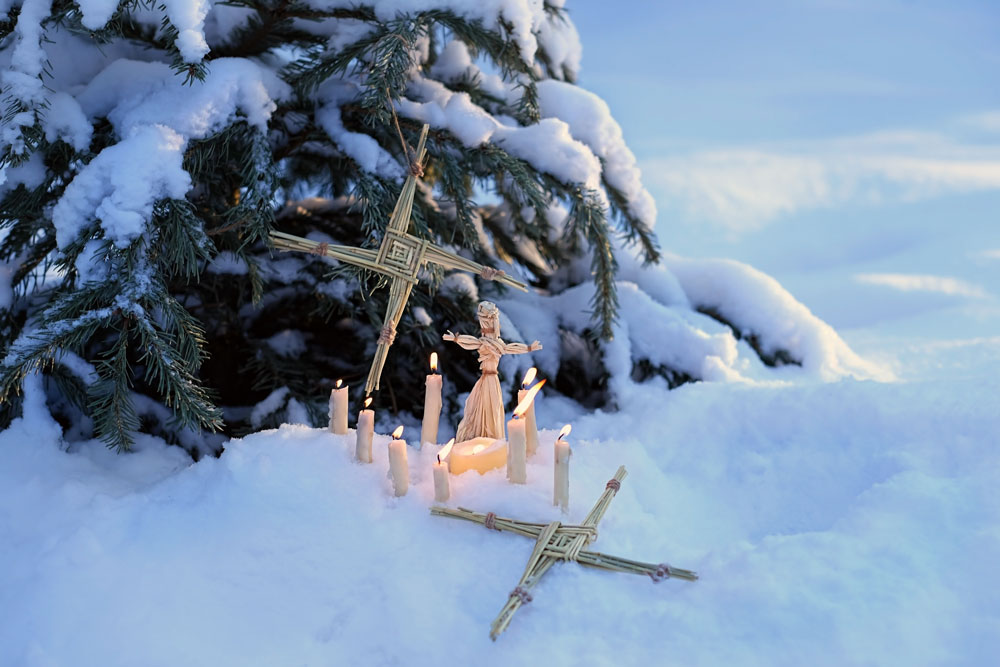
In the Northern Hemisphere, February 1st is the first cross quarter celebration of the new year. There is light twinkling in the darkness. The candles on the altar mirror the stars in the night sky. With the Winter Solstice, the daylight has begun to increase. Now that transition becomes noticeable as winter draws to a close and spring may be sensed on the horizon.
Known as Oimelc, or Imbolc, in Anglo-Saxon and Celtic calendars, the festival celebrates the child within the mother. The name, literally ‘ewe’s milk’ in Anglo-Saxon refers to the babe inside the womb of the mother. This marks the importance of breeding livestock and its intrinsic connection to the tides of the year.
The days are still cool but as the duration of daylight increases, we begin to feel that spring is coming. Oimelc is the glimmer of hope foretelling the end of the dark winter months.
In Ireland, they celebrate the Feast of St. Brigid—an only thinly veiled version of the pagan goddess of the same name. Crosses are woven out of straw and hung by the door to bring blessings of the Saint.
In Scotland’s Outer Hebrides, there was a tradition of women swaddling a sheaf of wheat in cloth and making a bed for it by the front door calling Brigid three times to come lay in her bed.
This night, we celebrate the light in winter. Though the days may have been colder, the stars have always been accompanying us. They reflect both the promise within the dark night as well as a beacon drawing us forward. The Star in the tarot and the Lenormand both reflect the notion of guidance or the path forward. Sailors took their reckoning from the starry heavens, gauging both speed and direction.
A our ancestors once asked for fertility of their livestock and a bountiful harvest, we can reckon the cross quarter cycle as times to focus on our own prosperity. Beginning today and continuing through to the metaphorical harvest.
It may be interesting to note that the concept of marking the changes of seasons with the equinoxes and solstices is particularly American. The seasons are really relative to one’s local climate. One may feel the impending onset of Spring on the first day of February far better in New Orleans than in northern New England. The seasons and meanings of the festivals are not written in stone and universal, they are relative and local.