
The Streams of the Rite
The United Rite is a confluence. Several streams of queer magical practice flow into it, each with its own source and following its own course: the witchcraft of the Minoan Brotherhood and British Traditional Craft; the Sethian and homophilic Thelema of the Brotherhood of SeTh; the Masonic Mysteries of the nineteenth-century traditions, reaching back to Memphis and Misraim; the apostolic succession and Sethian gnosis of the Gnostic Church; and the veiled male mysteries.
The Rite does not claim to be the only river where such waters meet. Queer men have found their way to the sacred along many courses, and other confluences run alongside this one. This is one place where these particular streams join, and the history of each propels the Rite into the future.
The Craft Stream
The oldest stream of the Rite is witchcraft. The Rite’s practice took root in British Traditional Witchcraft; the Craft descended from Gerald Gardner and was carried across the Atlantic. That Craft found its queer course in the Minoan Brotherhood, founded by Lord Gwydion (Eddie Buczynski), who “queered” the Gardnerian tradition and showed that the crooked path could also be a little bent.
The Rite’s Minos was initiated into the Brotherhood in New Orleans and later elevated to the degree of Minos. He received the care of the New Orleans Grove and a lineage that runs back through Lord Gwydion to the wider family of the Craft. The Grove remains the heart of the Rite.
As the Rite understands it, witchcraft was queer from the start: queer in the modern sense, and queer in the older sense of something askew, at the edge of the ordinary. Much of that history was hidden by the prejudices of early modern Wicca. The Rite’s work is to recover it.
The Brotherhood of SeTh
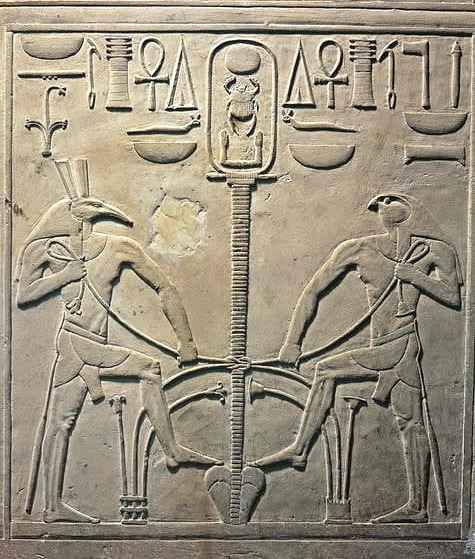
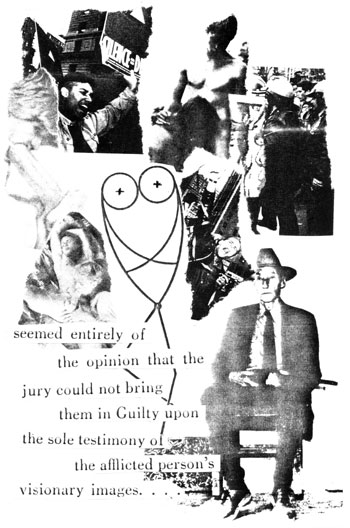
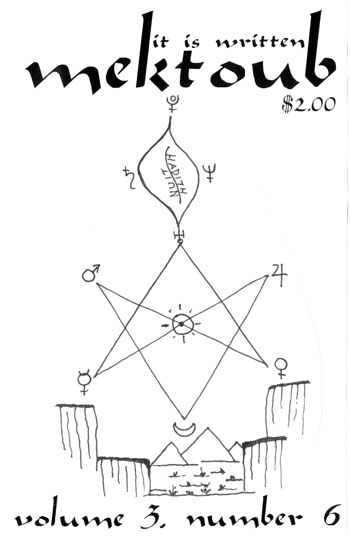
The Brotherhood of SeTh (T∴B∴O∴S) was a Thelemic working group, active from 1989 until it went dormant in the mid-1990s, devoted to awakening what it called the homophilic current. Its founders gathered in Portland, Maine, in the labyrinthine basement of a queer occult shop, which served as their temple. The Brotherhood found its central myth in Seth and Horus, the warring twins whose union gives birth to Thoth, and it drew on the cut-up and permutation work of William S. Burroughs and Brion Gysin as magical technique. From at least 1990 through 1993, it published the zine mektoub.
The Brotherhood was born in the midst of anger. Its first writings came as the AIDS crisis devastated a generation of gay men and the government answered with indifference. ACT UP took to the streets in 1987, and within months of the Brotherhood’s founding, Queer Nation formed, and the “I Hate Straights” broadsheet circulated at New York Pride. The Brotherhood’s early manifestos shared that militancy: a refusal to ask for tolerance from a culture willing to let queer men die.
Its claim was magical as well as political. Kenneth Grant had condemned the homosexual formula as one that “breeds devils in chaos.” The Brotherhood turned the accusation around: a magic that does not reproduce the existing order generates something new, offspring of spirit rather than flesh. That reversal runs through Breeding Devils in Chaos and into the United Rite.
A Sethian Order
The order’s name was written SeTh, or ShT, after the Qabalah of Frater Achad and Crowley’s word of power LAShTAL. Achad found the key to Liber AL in the number 31, shared by AL (God) and LA (Naught). Crowley added ShT as the third term, equal in value to the other two. In the Brotherhood’s reading, Set stands at the heart of the formula, “the catalyst between Nothingness (AL) and the Law (LA).”
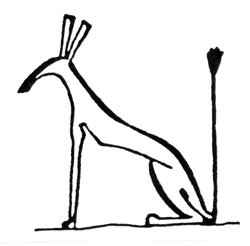
The Brotherhood took Set as its patron and explored his faces from early Egypt through the Hellenistic magical papyri to the Gnostic Seth of late antiquity. Crowley’s writings on the ShT deities, Set and Shaitan, gave the order its central current.
At the heart of its work was the other seed: the hidden or secret seed carried within the descendants of Seth. The ancient Sethians called themselves the seed of Seth, the “immovable race” through whom hidden knowledge is carried forward until its time. The Brotherhood understood itself as a Sethian order, bearers of that secret seed.
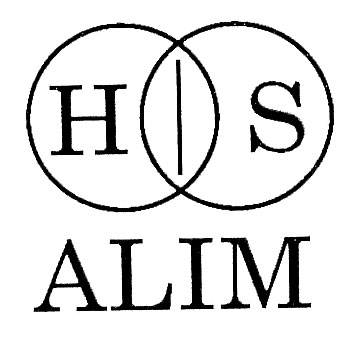
The Brotherhood’s letterhead bore Horus and Set in two joined circles above the word ALIM, the formula Crowley describes as the masculine plural of the masculine AL. Its number, 81, belongs to the moon, and Crowley calls it “the formula of witchcraft, which is under Hecate.” The emblem already held what the United Rite would later bring together.
The Brotherhood was not anti-heterosexual. “We are pro-homosexual,” the open letter insisted, and above all it advocated exploration. T∴B∴O∴S went dormant in the mid-1990s. Its writings, including “The Gnostic Seth,” “Sethian Genesis,” and “Tracking Seth,” were later gathered in The Star Set Matrix & Other Magickal Writings (Rebel Satori Press, 2014).
The United Rites of the Ancient Order of Oriental Templars
After the Brotherhood of SeTh, Typhaeus became involved with the United Rites of the Ancient Order of Oriental Templars (UR-OTO), an order organized in three axes: the Therionic, the Experimental, and the Traditional. For a time, he served as Grand Master General of the Traditional Axis, which held the older Masonic lines such as Memphis and Misraim, an office that also carried the care of the order’s Gnostic Church.
UR-OTO was not explicitly a queer order, though it counted queer and nonbinary members among its initiates.
From the Rites to the Rite
In time, it became clear that the plural titular name “United Rites” was inaccurate. The streams were many, but where they carried queer practitioners, they ran together as one water. Typhaeus left the UR-OTO, and the singular name of the United Rite marks that recognition: one confluence of queer praxis, set deliberately against the plurality of division.
The Gnostic Church and the XI°
When Typhaeus left the UR-OTO, he declared his branch of the Gnostic Church autocephalous and carried its apostolic succession into a new Rite. He merged the church with the Sethian Gnostic material of the Brotherhood of SeTh: the cosmology of the Monad, the Sophia, and the secret seed preserved in “Sethian Genesis.”
The church also took in the medieval legend of Seth’s quest for the Oil of Mercy. In that legend, Seth is refused the oil at the gates of paradise and given three seeds from the Tree of Life instead. He plants them in his dead father’s mouth, and from them grows the wood of the cross. In the Rite’s reading, the knowledge is “not fruit but seed”: hidden wisdom planted in humanity, carried through Seth’s descendants until the time is right.
In the same period, a Dutch brother conferred on Typhaeus the XI° of the Ordo Templi Orientis Antiqua, the degree Crowley set apart for male working, which is “inscrutable” and “dwells in its own palace.” It came as a transmission between brothers, not as membership in any OTO body.
In the Gnostic Church of the Rite, three strands of its queer magical inheritance meet: the Sethian gnosis of the Brotherhood of SeTh, the apostolic succession of the Gnostic Church, and the male mysteries of the XI°.
A Note on Lineage
The Rite tells these histories not to collect credentials. Lineage matters for what it carries, not for the titles attached to it. Every stream that flows into the Rite has changed course over the years, and the Rite will change too.
Our history is not our identity. Never the same river twice. We arise out of it and keep remaking ourselves, as every living tradition must. What the streams carry, and what the Rite carries, is the long recognition that queer men have always stood a little apart from the mundane, in the space between the seen and the unseen.
Header Image: Horus and Set Binding the Two Lands (Sema-Tawy): Relief from the throne of King Senusret I of the Middle Kingdom, 12th Dynasty. The contending deities Horus (patron of Lower Egypt) and Set (patron of Upper Egypt) tie the lotus and papyrus plants around the central sema sign, symbolizing breath, life, and political unification. Often carved onto the sides of pharaonic thrones, the motif expresses how legitimate kingship holds the opposing cosmic forces of order and disruption in balance. (Limestone, from el-Lisht. Now in the Egyptian Museum, Cairo. JE 31139)