
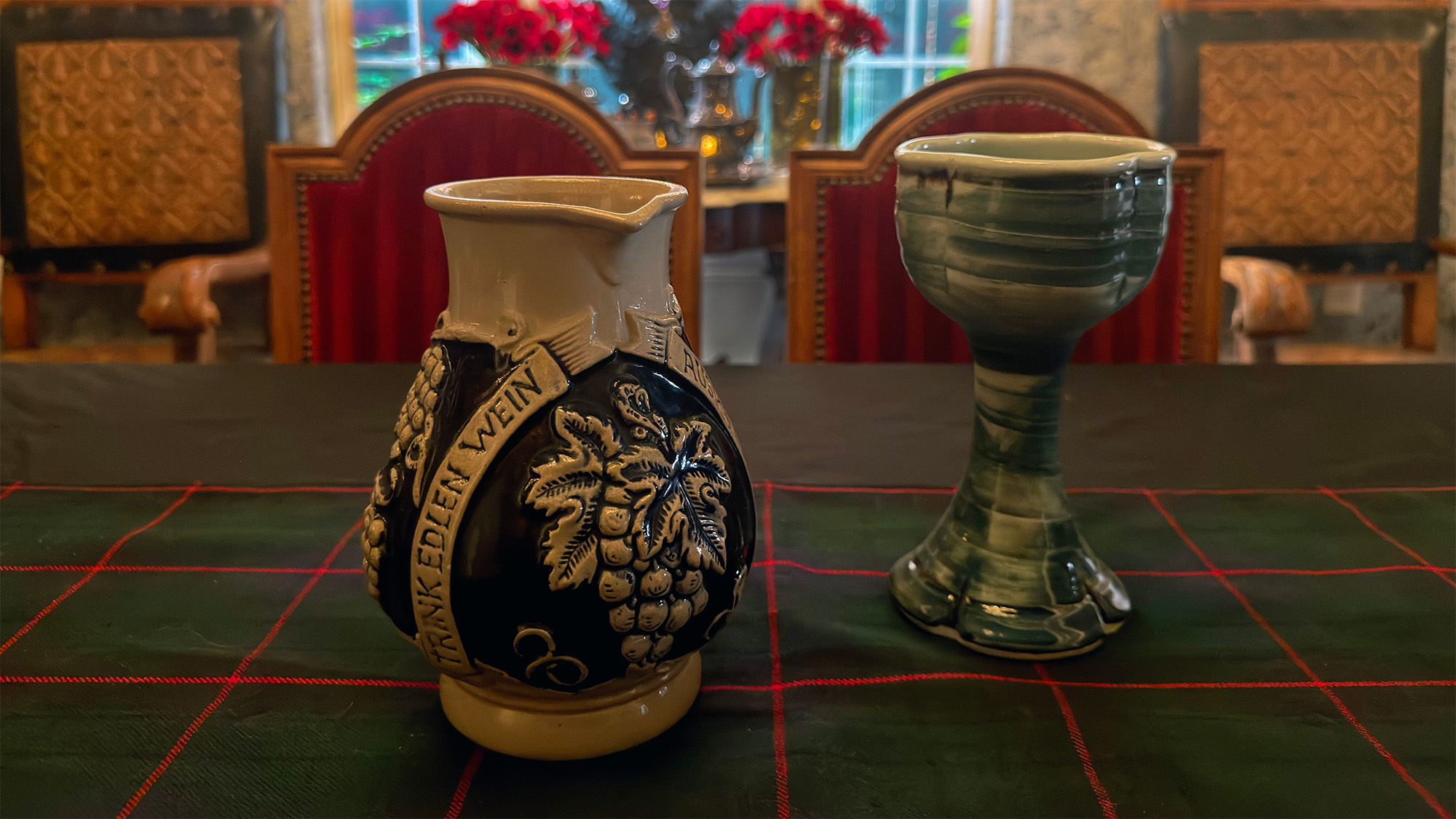
The Fog Moon rises full on Tuesday, November 24. It shines in Blōtmōnaþ, which the Anglo-Saxons called “Blood Month.” It was the time when the herds were thinned, and the meat was salted and smoked against the dark half of the year. Harvest Home is behind us. All Hallows has opened the door to the dead, and Midwinter waits ahead. This moon hangs between them, veiled in the mists of late autumn, in a season for taking stock, laying in, and deciding who will sit at our table when the cold comes.
This year the moon falls two days before many of us in the USA gather for Thanksgiving. Whatever we make of that holiday, the table it sets is one of the oldest things we do.
Every meal an offering
Our practice is full of shared food. At cakes and ale, we share with the gods. At the red meal, we offer our bread and wine to the spirits of nature and the intelligences of the land. At the dumb supper, we share silently with those who have gone across before us. And when we share food and drink with our community of brothers, we share our love, sitting together in fraternity.
Each of these is the same gesture turned toward a different guest. We give from our abundance freely, without expecting anything back, and in doing so we strengthen the bonds of trust that hold us. Neighbor taking care of neighbor was the heart of the ancient social compact, and it is the heart of ours. The holy covenant we enter is not only with the gods. It binds us to every brother who has come before us and every brother who will come after. We give freely, knowing that kindness will return to us in our own hour of need.
The ancestors’ feast
Two miles from Stonehenge lies Durrington Walls, a vast Neolithic settlement where the builders of the great stones most likely lived. Excavations there have turned up tens of thousands of animal bones, nearly all of them pig. Many were roasted over open fires and thrown away with meat still on them. There was more than enough to go around.
Two details make the site speak to us across the millennia. The pigs’ teeth show that most were killed at about nine months old: born in spring and slaughtered at midwinter. And their bones show that many were raised far away, in Scotland, northeast England, and west Wales, then driven on the hoof across the island to be shared. In the dark of the year, people walked the length of Britain to sit at one fire.
Fire and Food for the newcomer
The Hávamál, the sayings of the High One, opens with the duties a host owes a guest:
Fire he needs | who with frozen knees Has come from the cold without; Food and clothes | must the farer have, The man from the mountains come. (Hávamál 3, trans. Henry Adams Bellows)
Before questions and before stories come warmth, food, and a filled cup. The host’s hospitality is his honor. Quenching the thirst of a newly arrived guest builds trust between them and turns a stranger into a companion. When the ancestors gathered around the communal fire, they shared the tribe’s bounty and the elders’ wisdom at the same time. Food and story have always traveled together.
Introducing Common Fire
That is the spirit behind Common Fire, the United Rite’s new podcast, which premieres at Midwinter. It is a place to gather and listen: folklore, folkways, and cultural memory, seen through a queer lens. There will be one episode for each of the Holy Tides, with conversations with guests and talks on the old ways and what they offer us now.
We are building a hearth wide enough for brothers we haven’t met yet. That includes men in towns with no Grove, men who found the Craft alone, and men still on the mountain road with frozen knees. On a fog-bound night, a fire is how the lost traveler finds his way in. The ancestors gathered at midwinter around a shared fire, and we will light ours in the same dark season. Pull up a seat.
Listen for the first episode at Midwinter. Learn more →
A repast for the full moon
You might be at a crowded holiday table or alone at your altar. Either way, let one meal this week be kept on purpose. Set aside a first portion for the gods, a crumb for the land, and a cup for the dead. If you are eating with others, fill their cups before your own. In our rites, when the magister fills the cup with mead, ale, or wine, the gathered brothers drink first and the magister drinks last. As the cup or horn passes, we affirm our fraternal equality and the equipoise that underlies our pact.
If you are keeping this moon alone, pour a second cup for a brother you haven’t met yet. He is out there in the fog, on his way to the fire.
The simplest acts carry a legacy handed down through generations. In a world that so often pulls us apart, the shared table reminds us that we are never truly alone.