
The October Hunter’s Moon rises over a year that is turning toward its dark half. The harvest is in, the nights are lengthening, and our thoughts drift, as they do every fall, toward the Mighty and Beloved dead.
Among the early Puritan settlers of New England, prayer for the dead was rejected, and burial could proceed without spoken rites at the grave. Yet the work of tending the dead remained: neighbors built the coffin, dug the grave, and accompanied the body. Over time, mourning found expression in gloves, rings, cider, and spiced wine. Even where religious observance was restrained, the obligations of the living endured.
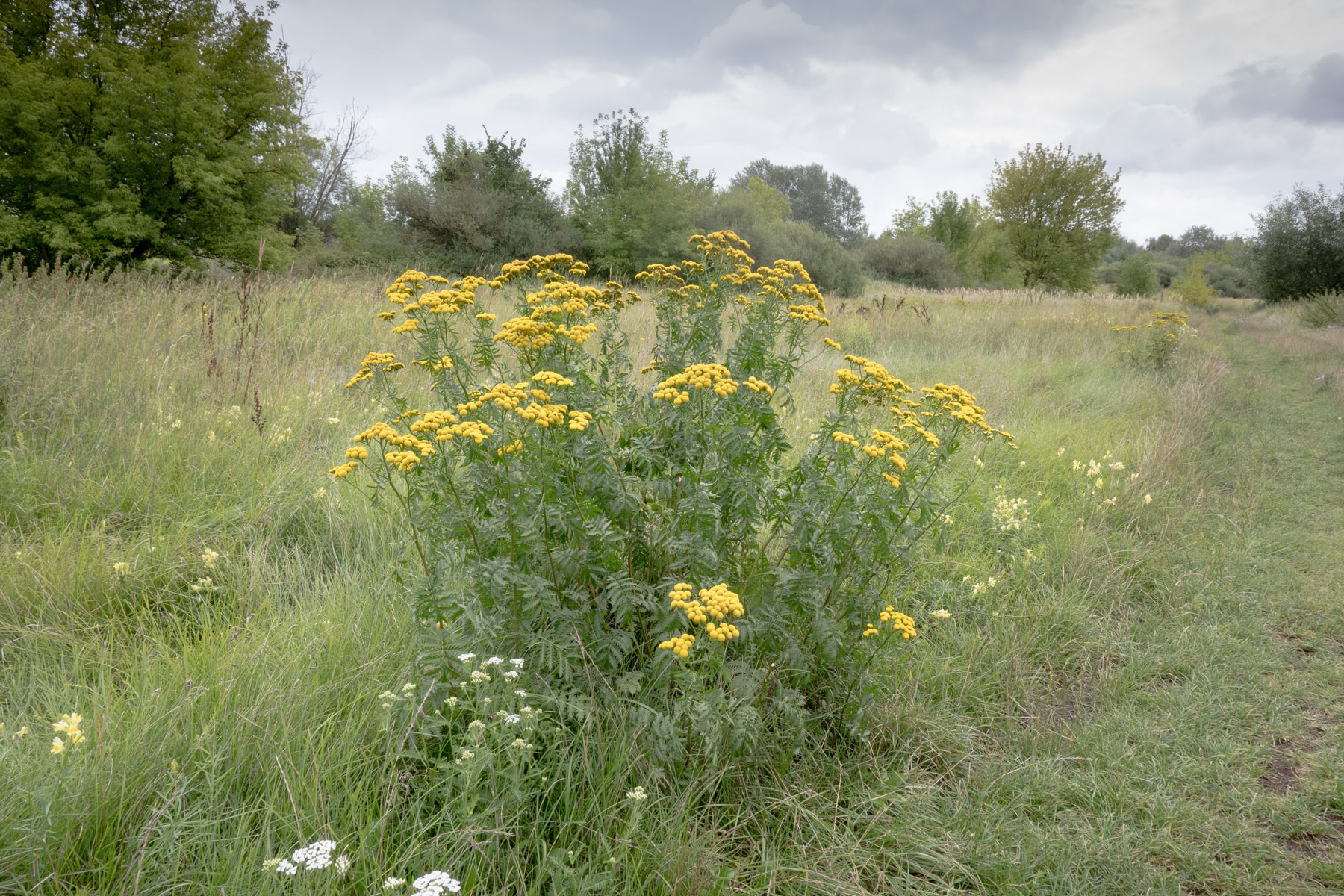
Herbs are another part of this story: the tending of the body, the furnishing of the coffin, and the ground around the grave. Among them was tansy, a familiar naturalized plant whose association with burial offers us a way to reflect on the duty of keeping watch. I remember its tall stalks and sturdy yellow flowers along the edge of my family’s property, where fields gave way to woods.
It occupied the mearc, as my Anglo-Saxon forebears would have called it: the border country between the tended tūn (“the tended enclosure”) and the wild beyond, belonging fully to neither. It grew where hedge-witches are said to sit, on the boundary between the tended and the feral. It occupied the space along the fence line, between what my Norse ancestors called innangarðs and útangarðs: the world within the fence and the world beyond it.
Tansy’s story in New England runs from the garden to the burying ground, through accounts of its use in coffins and funeral wreaths. Its name, Tanacetum, is often linked to the Greek for immortality, an association echoed in the enduring form of its dried, gold button-flowers. For some, its funeral associations made the plant unwelcome. Yet beyond the dooryard, it persisted along roadsides, carrying its old associations into the ordinary landscape.
What draws me to tansy is not death itself, but the duty of tending what death leaves in our care. In our work, we can approach it as an herb of stern guardianship, a keeper of the threshold. Where other everlastings speak of remembrance, tansy speaks of responsibility: the discipline of keeping watch and doing what necessity demands, however hard the task.
That is a fitting teacher for this moon, when we remember those who kept watch before us and consider what has now been entrusted to our care.
A practice for this full moon
If you can, visit the grave of someone whose memory you wish to honor: a family member, a teacher, or a stranger in an old burying ground whose name has worn nearly smooth. Spend a little time in quiet attention. Where cemetery rules permit, gather loose litter or leave a flower, taking care not to disturb the stone or its plantings. No herb is required. The offering is your presence and the care you bring.
If you cannot visit a grave, set aside a quiet place at home. Light a candle if it is safe to do so, and name aloud the dead you choose to honor. Kinship is not only a matter of blood; we may remember teachers, friends, and those whose work made a path for our own. Let remembrance become a commitment: choose one act of care through which their legacy may continue.
A caution: tansy is toxic and should never be taken internally. This practice does not require handling or using it. Cooks once flavored puddings with its leaves; it is safest to leave that practice in the past.
Blessings under the full moon,
