
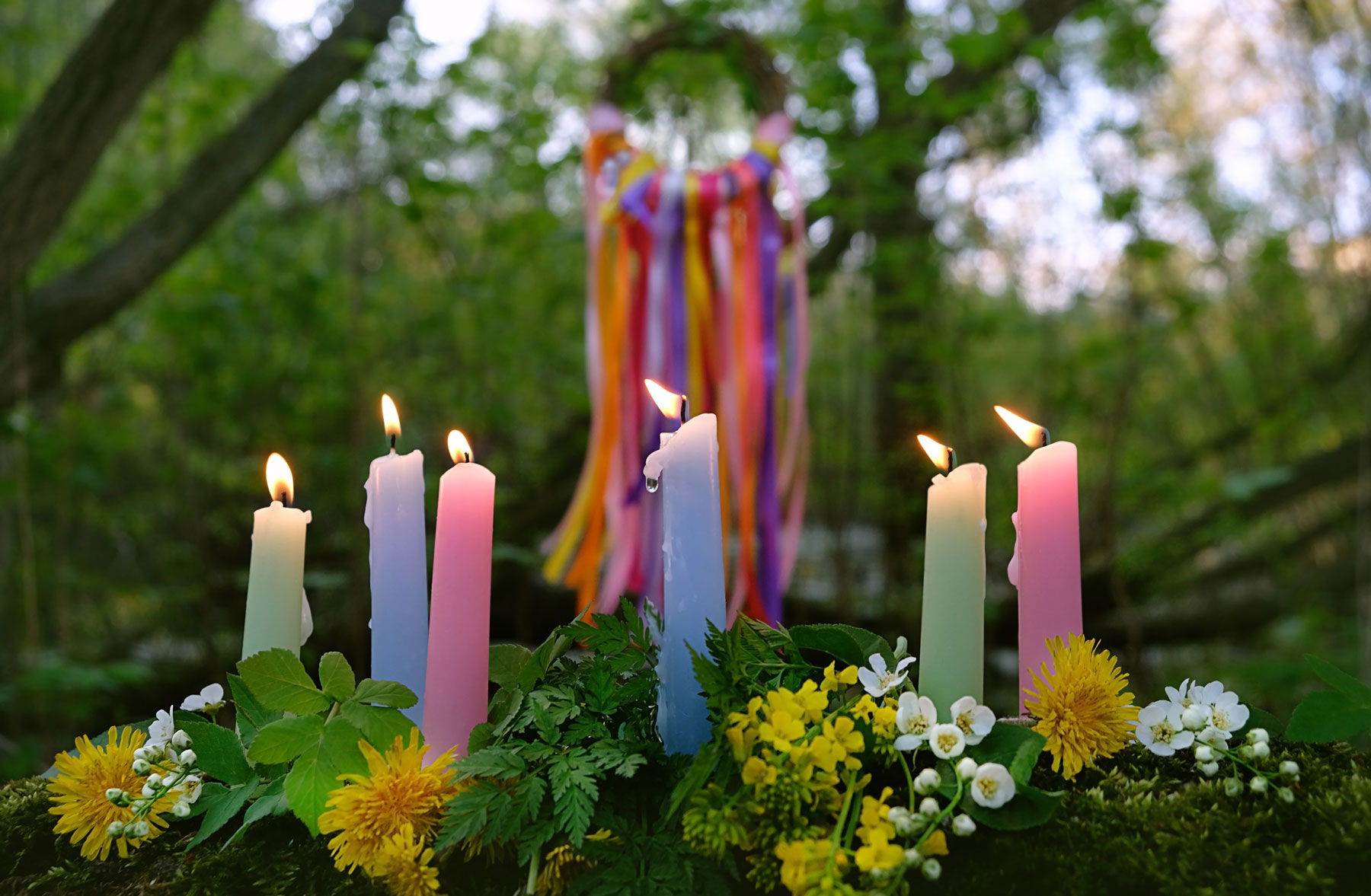
Beltane—Bealltainn in Scots Gaelic—is one of the great historic fire festivals of the Gaelic world. What was seeded at Oimelc now begins to ripen: fertility moves from promise to fulfillment. Traditionally, fires were kindled on the hills, and pregnant women leaped across the flames to seek a safe birth. The Druids, it is said, drove cattle between twin fires to bless them before they were taken to the summer pastures. On the continent, related celebrations follow the rhythm of pastoral northern Europe; among the Norse, this is “Summer Finding,” the clear turn into the bright half of the year. The Maypole, with its painted pole and bright ribbons, enters the scene here—originally a German custom carried to Britain with the Anglo‑Saxon migration—circling and weaving the energies of land and people together.
At Beltane, we celebrate the fertile potency of the Earth, both the great living planet and the soil beneath 79our feet. The Horned God is entirely out in the land: the young stag’s antlers are forming, the roe deer’s shed horns are regrowing, and the animals’ rutting season is in full swing. In Scotland, the summer goddess Brìghde takes the place of the winter Cailleach as the season’s lady. Among the Anglo‑Saxons, this was the Festival of Flowers, Blostmfreols, in the month called Þrimilcemonaþ, “triple‑milking,” when herds were moved to summer grazing, and milk flowed at its richest. In keeping with that older current, we mark the Feast as a time of rising productivity and delight, dressing the altar with local spring flowers and honoring the land’s overflowing, sensual abundance.
–Excerpt from The United Rite: Brother Walking with Brother
Every year, as April turns to May, we gather in communities to honor Beltane—a festival rooted deeply in the Gaelic traditions, with echoes heard across the globe. The above excerpt captures the vibrancy and meaning of the festival, yet so much more lies beneath the surface.
At its core, Beltane is a festival of fire. The communal bonfires lit on hilltops are not just spectacles; they are rituals of purification and blessing. Pregnant women once leapt across the flames, seeking protection for their unborn children, and cattle were driven between twin fires for luck and health before heading to summer pastures. The fire is transformative—it marks the shift from the tentative promise of spring to the full-blown fertility of early summer.
Beltane’s themes of renewal and abundance are not confined to the Gaelic world. On the continent, similar festivals celebrate the same turning point in the year. Among the Norse, “Summer Finding” signals the arrival of the bright half of the year, while in Anglo-Saxon England, Blostmfreols, the Festival of Flowers, ushers in the month of Þrimilcemonaþ (“triple-milking”), when herds graze, and milk flows at its richest.
The male figure of divinity is reaching maturity in the annual cycle. One of Beltane’s enduring symbols is the Maypole—its painted shaft festooned with bright ribbons, weaving together the energies of land and people. Rooted in medieval European spring celebrations, the Maypole dance reflects communal joy and the return of warmth and growth, with later traditions adding the colorful ribbon‑weaving we know today.
May Day is a time to acknowledge the Earth’s potency. We adorn our altars with local spring flowers, honoring the land’s overflowing abundance. The Horned God roams the fields, his antlers forming, his power rising. In Scotland, the goddess Brìghde replaces the winter Cailleach, embodying the warmth and vitality of the season.
Today, we continue to celebrate the rhythms of the Earth. The May full moon invites us to connect—both to our ancestors and to the living world around us. It is a moment to revel in the sensual abundance of spring, to honor the cycles of birth and growth, and to kindle our own inner fires for the months ahead.
As the excerpt suggests, today is more than a festival; it is a living, breathing rite that invites us to walk in step with the turning seasons, celebrating not just the Earth’s fertility, but our own capacity for joy, creativity, and renewal.