

I was saddened to learn that Llee Heflin passed away earlier this fall—his passing marks another poignant moment in the ongoing history of queer liberation and radical magick. Llee’s life was a fusion of activism, art, and magick—his legacy reminds us that queer liberation and occult practice can be inseparable acts of resistance.
Llee was much more than an occultist; he was a radical visionary who stood at the crossroads of queer liberation and esoteric experimentation. As an early member of the Los Angeles Gay Liberation Front (GLF), Llee helped shape some of the most daring moments in LGBTQ history. The GLF was renowned for its guerrilla theater, bold political actions, and for founding the first nonprofit LGBTQ center in the United States. Llee was both politically and spiritually engaged—he saw magick as a tool for queer empowerment as much as resistance.
In a 2009 email to me, Llee summed up his magical journey: “I did almost no Magickal ‘Workings’ in the traditional sense. A. C.’s Magickal Practice was of little interest to me. I was far more interested in his philosophical and epistemological ideas than in ceremonial magick. i engaged in none of that. ‘Magick’ was/is for me all of the non-ordinary experience that just ‘appeared out of no where’, as it were. Magick happened to me; it was not something I did. I was going to call it “unbidden”, but in that moment I realized that that is not really true. I did invoke it; I did seek it and ask for it and desire it. But my ‘invocation’ was/is in the intensity, earnestness, steadfastness of my longing for it and Will towards it. I did Magick without knowing that that was what I was doing. My quest for information/knowledge was a quest for information/knowledge about the ‘unknown destination’ towards which I was groping my way in the dark, information/knowledge about how and where I was going to take my next step.”
Llee’s occult path was deeply intertwined with Crowleyan traditions, but what set him apart was his radical reimagining of ritual from a queer perspective. His landmark 1973 book, The Island Dialogues: A Book from Darkness, is an extraordinary exploration of queer spirituality—a rare and still-underrated text in both LGBTQ and occult circles. In it, Llee crafts a literary and ritual journey where psychoactive states, sensuality, and sex magick are central themes, not peripheral ones. He envisioned magick as an act of creation: a means to challenge the grip of heteronormativity and envision alternate worlds where queer bodies, relationships, and desires became sacred.
The Island Dialogues is a spiritual manifesto of sorts, a call to embrace queer experience as mystical and revolutionary. In this psychedelic travelogue, Llee describes a mythic landscape inhabited by seekers whose passage through darkness is illuminated by transformation, communion, and erotic power. He wrote openly of negotiating shame, navigating altered states, and conjuring “magik babies”—entities (or ideas) conceived through communal ritual. His work blurred the boundaries of activism and enchantment, inviting us to see spiritual practice as a source of collective, embodied liberation.
His early activism carried the energy of ritual theater. The Biltmore Rebellion of 1970, where GLF activists dramatically disrupted a conference supporting electroshock “therapy” for homosexuality, became both a protest and a collective spell. It was a banishing—a sacred act of defiance. The GLF’s later attempt to found “Stonewall Nation” in Alpine County was an equally visionary act, blending separatist idealism with utopian occultism. For Llee, these actions were never hollow political gestures—they were rituals, charged with magick, aimed at manifesting the world queer people could thrive in.
In my personal experience, Llee’s outlook was also very realistic. He called it as he saw it. Writing in the same 2009 email quoted above, he observed: “There is an old occult saying that, I think, holds some truth: ‘Ask and ye shall receive. Knock and It shall be opened unto you.’ The reason that this does not ‘work’ for most would-be magickians and seekers is that they are not totally committed to the Asking and Knocking. They are not willing to give all in order to receive all.”
Llee spent the last forty years of his life living in what he described to me as “splendid isolation,” working as a chef in Eureka Springs. Enduring Legacy Llee’s story reminds us that queer magick is more than candles and incantations—it is the reclaiming of power, the rewriting of oppressive narratives, and an act of embodied liberation. Llee’s synthesis of art, activism, and occult practice continues to inspire contemporary queer spiritual movements, where ritual and resistance are forever intertwined.
To remember Llee is to honor someone who refused to choose between mysticism and rebellion; his legacy endures wherever queer magic flourishes—in the rituals we create, the stories we tell, and in every act of radical love and resistance. His magick was fiercely queer, his activism enchanted, and it is up to us to ensure his legacy endures for future generations.
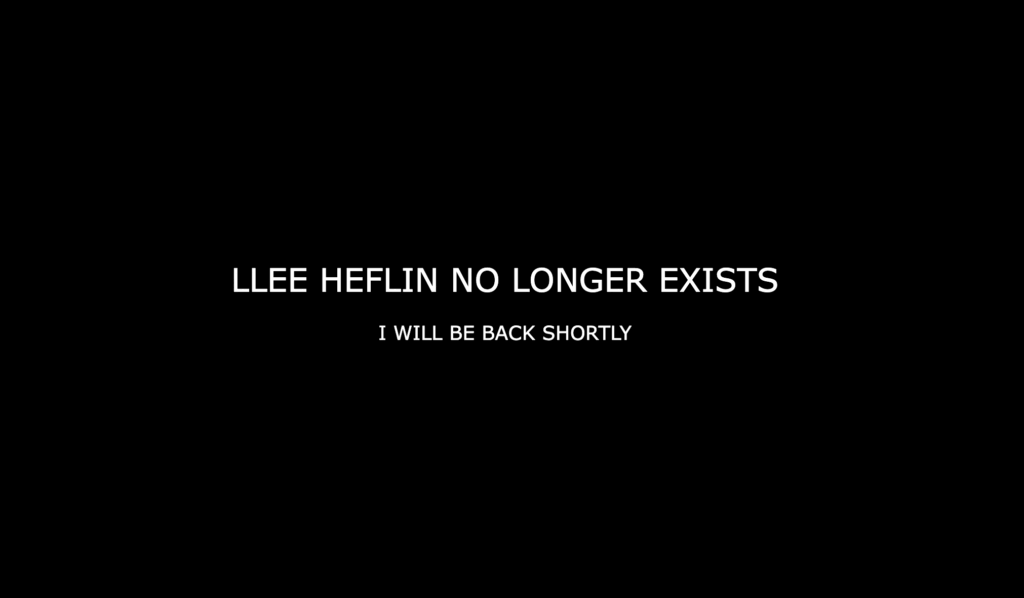
On his website, he leaves us with this simple message:
Featured photo: Left to right: Llee Heflin, Stanley Williams, and John Platania walking in Hollywood, photograph by Grey Villet for Life magazine, 1971, © Time Inc. https://images.google.com/hosted/life/3edde5fc2e8e884e.html